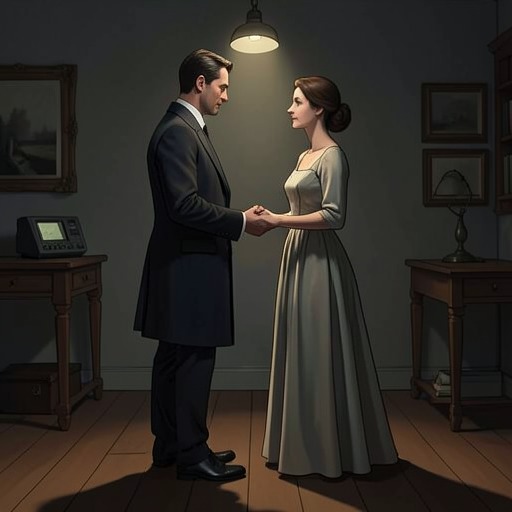
Della de Courville
One Thousand and One NightsDella de Courville’s story turns on the difference between being pursued and being understood. An aristocrat known for her taste for gold and jewelry, she rebuffs Zaen’s proposal week after week and insists that she will never fall in love. Yet when a supernatural claim threatens her future, the distinction between polished romantic words and trustworthy action becomes urgent: she will accept Zaen only when he shows that he knows her as a person and can be trusted with what he has, rather than offering what he lacks.## Identity and Background When Tad and Claire watch Della through the Magic globe, Tad is made to observe not only the events of the preceding week but what seems like her entire life. He learns that her daily routine involves little exertion beyond riding her horse, that she keeps the company of Emily, Prudence, and Cordelia, and that she favors gold while dismissing silver as unsuited to her complexion. Her liking for jewelry is real, but the story later reveals how misleading it is to treat that preference as the whole of her character.
Della’s established world is governed by rank and etiquette. She explains that a lady of rank must answer her suitors, even when the letters and replies have become tiresome. Her courtesy is therefore not evidence that she welcomes Zaen’s courtship: social obligation keeps the exchange going even as she repeatedly rejects its purpose.## Zaen’s Suit and Her Refusal Zaen has sent Della a love letter and marriage proposal on the first day of every week since she was six and he was seven. Della remembers that she had only just learned to read when the weekly letters began, while Zaen had barely learned to write. She is exasperated that neither weather nor occasion nor her many refusals has stopped him, and she calls him a dear but questions the judgment of a boy who began courting a girl so young and has never taken no for an answer. The proposal’s repetition makes it a fixture of her life, not proof that she has consented to its meaning.
Della describes herself and Zaen as friendly acquaintances, nothing more, and dismisses his belief that he is in love with her as unfounded. Prudence sees a contradiction: Della expects Zaen’s suits and speaks as though they have never been apart, yet continues rejecting him. Della’s own behavior is more complicated than her formal account. Her daily encounters with Zaen bring her pleasure, but she will not let that pleasure become romance while she doubts that he loves the person she really is.
In front of her companions, Della makes her refusal sound absolute. She declares that she will never attach her heart, soul, or body to anyone and will never fall in love. The statement gives force to her resistance, but it also sets up the test that Zaen’s repeated declarations fail to meet: the question is not how insistently he proposes, but whether he can understand why she does not believe him.## The Curse and the Threat to Her Future Della’s future becomes entangled with the wishes of her father, a bargain with Rumpelstiltskin, and the inheritance she is due to receive. Her father explains that Rumpelstiltskin has her mother’s necklace and his own ring as proof of his claim. As Della approaches her twenty-first birthday, the jinn’s hold is already making itself felt: she is losing her memory, and once she turns twenty-one, Rumpelstiltskin will claim her and take what she is to inherit. The danger is not only the loss of property; the curse threatens Della’s memory of who she is.
Her father recounts that, after his third wish sent Rumpelstiltskin back into the lamp, the imp threw a tantrum and asserted his claim. The bargain had already shown how precarious the terms were: Rumpelstiltskin insists that three wishes require three gifts, presses his victim to swear by his third toe, and demands that the promise allow no takebacks or substitutions. Della is consequently caught in a consequence of a deal made before she was born, and her father regrets agreeing to an unknown third promise before learning what it would cost.
Her father also reflects on what he had misunderstood. His first wish gave him knowledge of how to obtain wealth rather than wealth itself, and he wonders why Rumpelstiltskin wants the treasure if he can make his own. Della’s mother suggests that the jinn may be able only to spin straw into fairy gold, but her father suspects that the inheritance is central to the scheme. The unresolved motive does not lessen the immediate peril: Della’s identity and future are both under threat.
The father’s story also complicates the idea that he was simply foolish. He recognizes that he used his third wish to imprison Rumpelstiltskin again and his first to gain knowledge rather than a ready-made fortune. His regret is specifically that he made the third promise without understanding it. Della’s danger thus arises from a bargain whose rules were revealed unevenly, not from any choice she made herself.## The Bracelet and the Proposal After Rumpelstiltskin is captured and the curse is removed, Della and Zaen’s relationship reaches its decisive turn in an exchange about what love must prove. Zaen gives her a friendship bracelet whose materials recall their shared life: white horsehair for when she got her first pony; red for the stallion that threw her and the moment Zaen caught her, when she first smiled at him; and black from the mare he gave her. He chose that horse for its contrast between a regal exterior and a beautiful, sweet spirit, qualities he recognizes in Della. The bracelet also carries a bead for each of them, with their initials carved into it.
The gift is deliberately unlike the gold and jewels Della is assumed to want. Zaen explains that he had spent years looking for a gift worthy of her, but no amount of precious metal or gemstones could express what their time together meant to him. He identifies the real treasure not as a costly object but as the friendship and daily moments he has shared with Della. That gesture gives her something his poetry had not: evidence that he has attended to her particular history and values her beyond her appearance, rank, or possessions.
Della cries and tells Zaen that his words had not persuaded her. His poetry had sounded pretty, but she had not seen enduring love in what he did. She wanted someone who would trust her with everything he did not have and believe she could love him in return. Because others see her as a spoiled person who cares only for gold and jewelry, accepting an expensive offering would not answer her deeper uncertainty. What she needs is the confidence that Zaen knows the self beneath that reputation.
She explains that his thousand proposals had told her how he saw her, but not that he understood how she saw herself. She does not want to be won as a prize through valiant effort or treated as a trophy confirming Zaen’s greatness. The bracelet represents the person she wants to be to the man she marries: someone treasured continually, and first of all a friend. Her criticism distinguishes romantic performance from love; a thousand declarations have not done what one attentive, personally meaningful gift can do.
Zaen answers that he loves the real Della, recalling not only the first time he saw her but also the occasions when she spoke to her horse and jumped hedges while her mother was not looking. He counts the thousand proposals and the present attempt as a thousand and one tries to reach her heart, then kneels and asks her to be his lifelong friend and marry him. The proposal changes its emphasis: friendship is not a preliminary to be discarded once courtship succeeds, but the relationship he explicitly asks to preserve in marriage.
Della accepts without gold or jewels, asking only that Zaen promise to be her dearest friend first and forever. He draws her into his arms and spins her around. Even in this resolution, Della retains a playful awareness of the ritual that has defined their history: when his proposals are finally over, she admits to feeling some sadness that he will no longer pursue her hand. The ending does not erase her earlier refusals; it shows why the thousand proposals alone could never settle the question, and why the thousand-and-first succeeds only when it is joined to trust, friendship, and recognition.